Why Doesn't Honey Spoil? The Chemistry Behind Its Long Life
September 8, 2026 · The3Beez
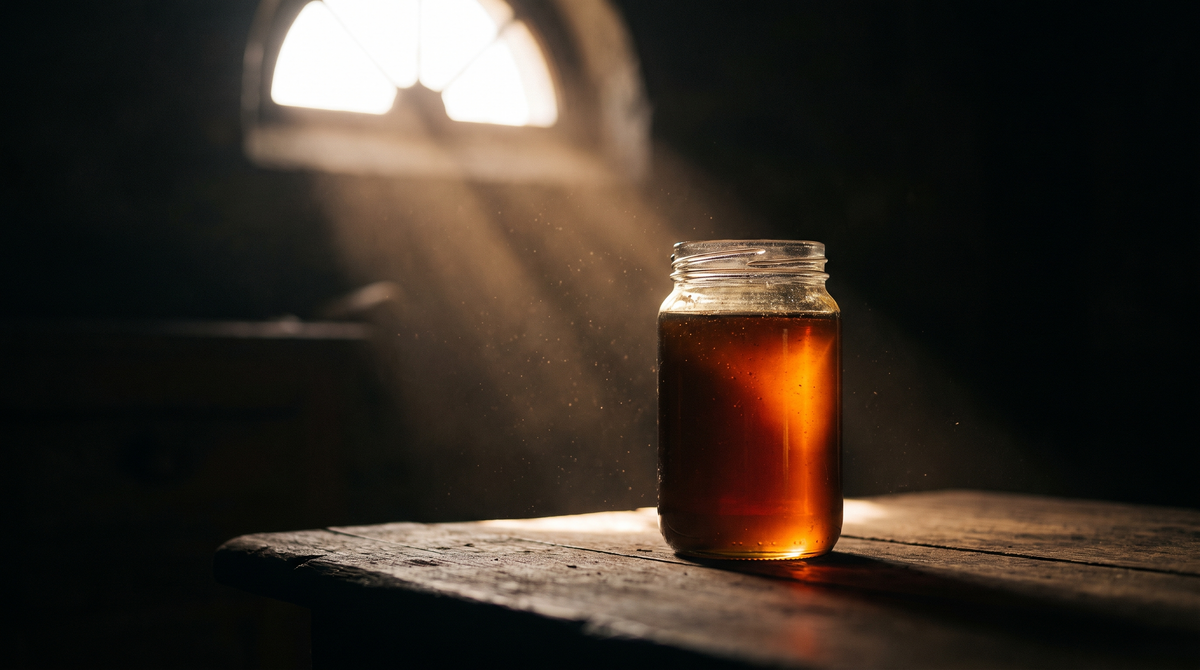
It is often said that honey does not spoil. The statement is true in essence, but it needs precision: honey is highly resistant to microbial growth, not immortal. The reason is three factors working together.
First: Very Little Water
The water content of ripe honey is below 20% under the Codex Alimentarius standard, and in most measured samples it falls between 16% and 19%. More important than the water figure is the low water activity: the concentrated sugars bind the water molecules and deny them to bacteria and yeasts, drawing water out of any microbial cell that comes close.
Second: Acidity
Blossom honeys are acidic, with a pH usually between 3.5 and 4.5. Honeydew honeys and some monofloral honeys sit higher than that; a Saudi sider sample was measured at 5.07. The dominant acid is gluconic acid, a direct product of the glucose oxidase enzyme that the bees add.
Third: Hydrogen Peroxide
The same reaction that produces gluconic acid also produces hydrogen peroxide. A study published in Frontiers in Microbiology measured concentrations ranging between 0.248 and 2.68 millimolar in honey samples. These three together — unavailable water, acidity and peroxide — explain why honey stays sound for years in a tightly sealed container.
But Honey Can Ferment
If honey absorbs moisture from the air until its water content passes the safe limit, sugar-tolerant yeasts may become active and fermentation begins. That is why a tight seal is not a cosmetic detail.
A Warning That Has Nothing to Do with Spoilage
Honey is not given to a child under one year old. The reason is not spoilage but that spores of the bacterium Clostridium botulinum may be present in natural honey and cause infant botulism. This is an official warning issued by the US Centers for Disease Control and Prevention, and it applies to every kind of honey, including pasteurized honey, because pasteurization does not kill these spores.
And What About the Honey from the Pharaonic Tombs?
The popular story says that archaeologists found edible honey three thousand years old. There is no excavation report, museum publication or peer-reviewed paper documenting this event, and the story circulates only on aggregator sites. What is genuinely documented is something else: that honey was a routine offering commodity in ancient Egypt, and that the chemical residues of beeswax have been detected in Neolithic pottery. Honey's resistance to spoilage is an established fact; the tomb story has nothing to support it.